FX Forwards: Contract Creation Revamp
FX Forwards: Contract Creation Revamp
FX Forwards: Contract Creation Revamp
Scaling a manual service into a high-confidence
digital workflow
Scaling a manual service into a high-confidence digital workflow
Background
Despite being a high-margin product, FX Forwards growth lagged behind our core FX suite due to a legacy interface that lacked professional sophistication since 2021. I led the revamp of the contract creation process to remove operational bottlenecks and empower users to trade independently.
Background
Despite being a high-margin product, FX Forwards growth lagged behind our core FX suite due to a legacy interface that lacked professional sophistication since 2021. I led the revamp of the contract creation process to remove operational bottlenecks and empower users to trade independently.
Role
Product Designer for Treasury Tribe
Timeline
2 months (2024)
Team
1 Product Owner, 3 Engineers
Tools
Figma, Figjam
Background
Despite being a high-margin product, FX Forwards growth lagged behind our core FX suite due to a legacy interface that lacked professional sophistication since 2021. I led the revamp of the contract creation process to remove operational bottlenecks and empower users to trade independently.
Background
Despite being a high-margin product, FX Forwards growth lagged behind our core FX suite due to a legacy interface that lacked professional sophistication since 2021. I led the revamp of the contract creation process to remove operational bottlenecks and empower users to trade independently.
Role
Product Designer for Treasury Tribe
Timeline
2 months (2024)
Team
1 Product Owner, 3 Engineers
Tools
Figma, Figjam
Business Problem
Service vs. Tool
Currently our own sales specialists manually process 95% of all FX Forwards orders. This is a result of this product's own nature in the industry and the overly opaque legacy interface, which turns it into an operational bottleneck despite its profitability.
Ambiguous UX had an impact of around £156k+ in potential monthly risk. To preserve client relationships, Ops had to navigate manual cancellation layers to waive penalty fees, creating a cycle of high operational risk.
Business Problem
Service vs. Tool
Currently our own sales specialists manually process 95% of all FX Forwards orders. This is a result of this product's own nature in the industry and the overly opaque legacy interface, which turns it into an operational bottleneck despite its profitability.
Ambiguous UX had an impact of around £156k+ in potential monthly risk. To preserve client relationships, Ops had to navigate manual cancellation layers to waive penalty fees, creating a cycle of high operational risk.
Business Problem
Service vs. Tool
Currently our own sales specialists manually process 95% of all FX Forwards orders. This is a result of this product's own nature in the industry and the overly opaque legacy interface, which turns it into an operational bottleneck despite its profitability.
Ambiguous UX had an impact of around £156k+ in potential monthly risk. To preserve client relationships, Ops had to navigate manual cancellation layers to waive penalty fees, creating a cycle of high operational risk.
Connect CMS Image fields (Image 1–10)
User Pain
High stakes and low clarity
Since the access to end-users was limited, I interviewed both Sales and Ops and mapped the mental models of traders who were currently avoiding the self-service.
For a treasurer managing multi-million-pound hedges, the platform could feel like a trap:
Directional anxiety
Manual rate calculation
Double-charge fear
User Pain
High stakes and low clarity
Since the access to end-users was limited, I interviewed both Sales and Ops and mapped the mental models of traders who were currently avoiding the self-service.
For a treasurer managing multi-million-pound hedges, the platform could feel like a trap:
Directional anxiety
Manual rate calculation
Double-charge fear
User Pain
High stakes and low clarity
Since the access to end-users was limited, I interviewed both Sales and Ops and mapped the mental models of traders who were currently avoiding the self-service.
For a treasurer managing multi-million-pound hedges, the platform could feel like a trap:
Directional anxiety
Manual rate calculation
Double-charge fear
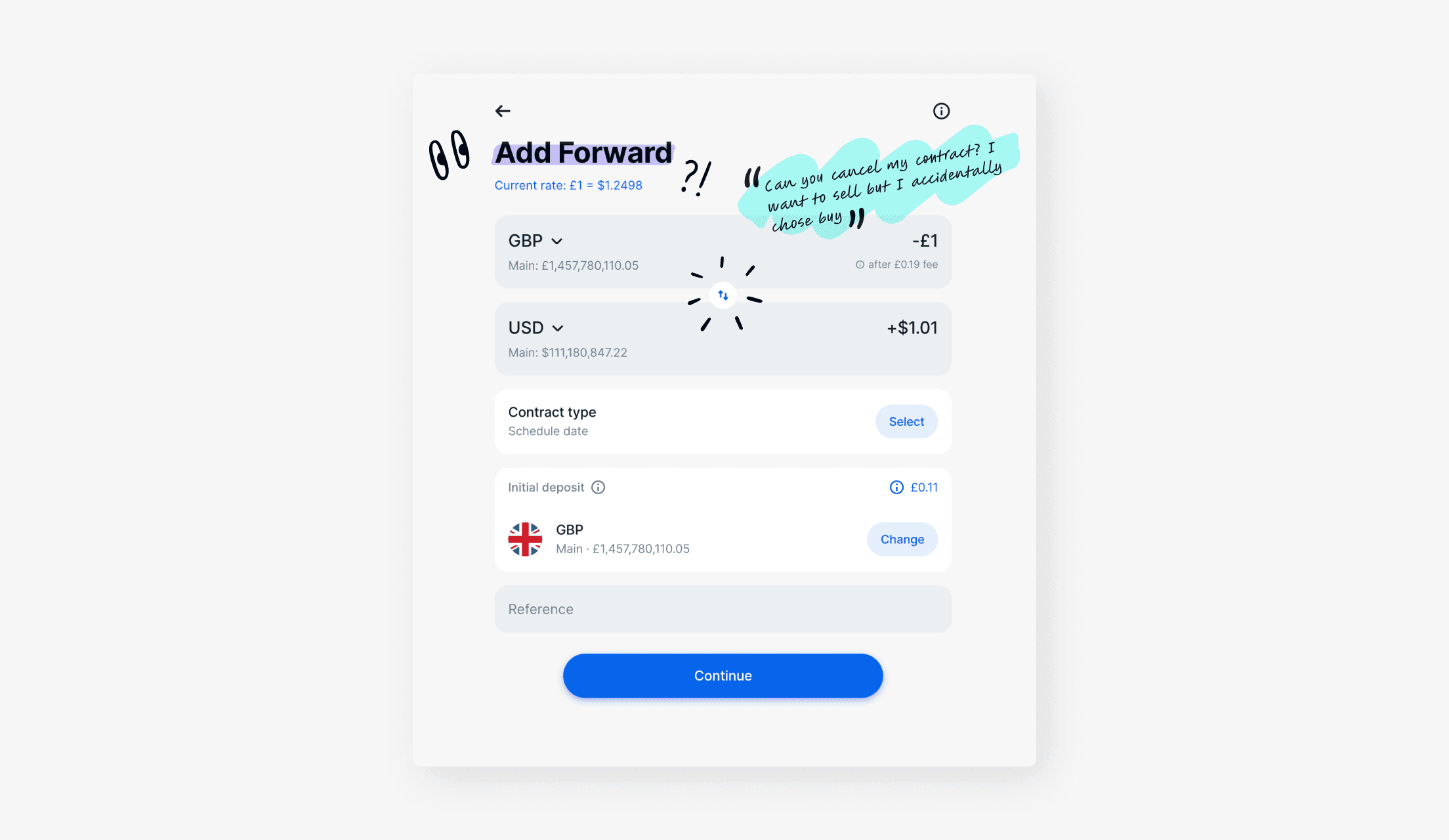
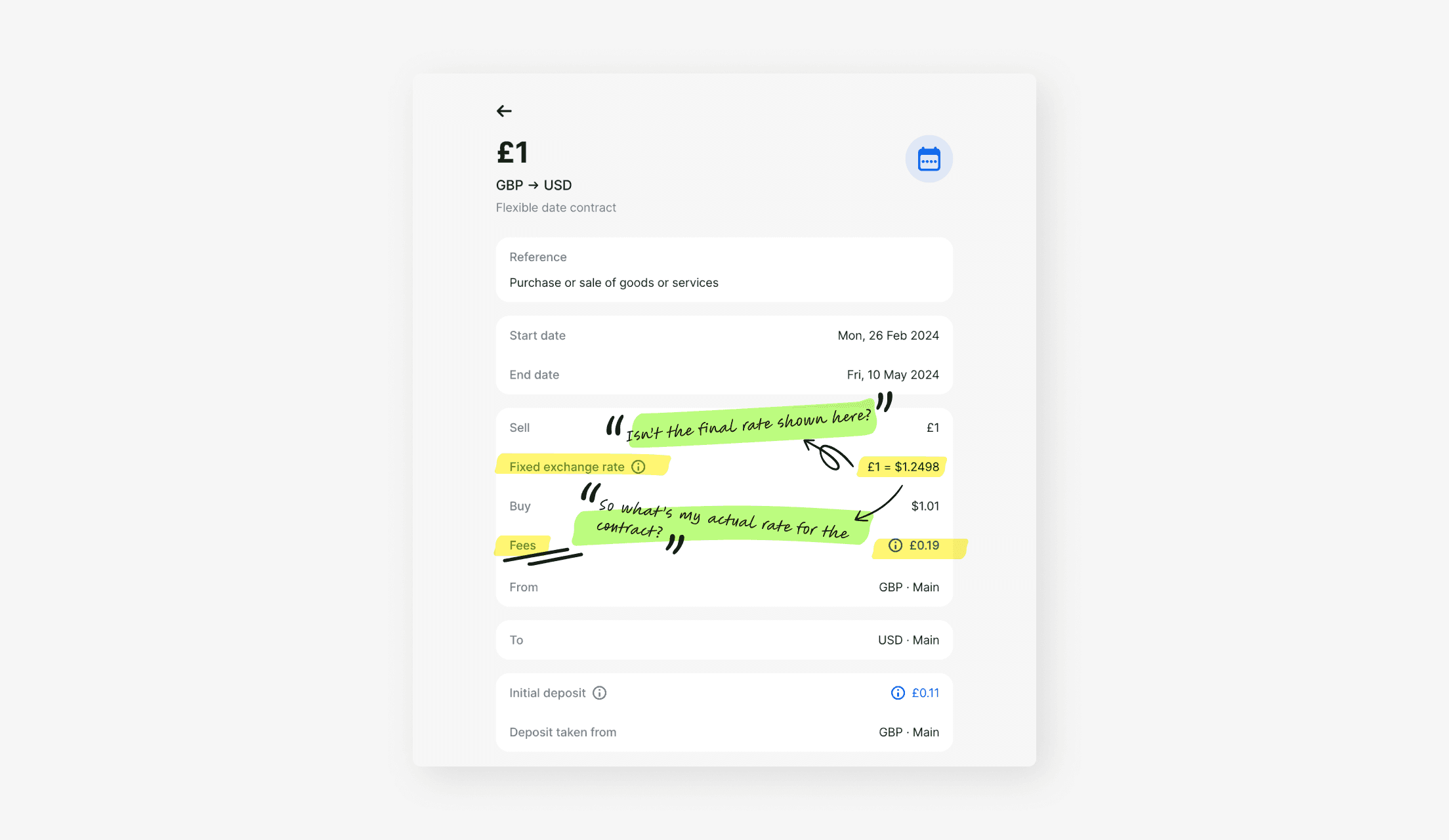
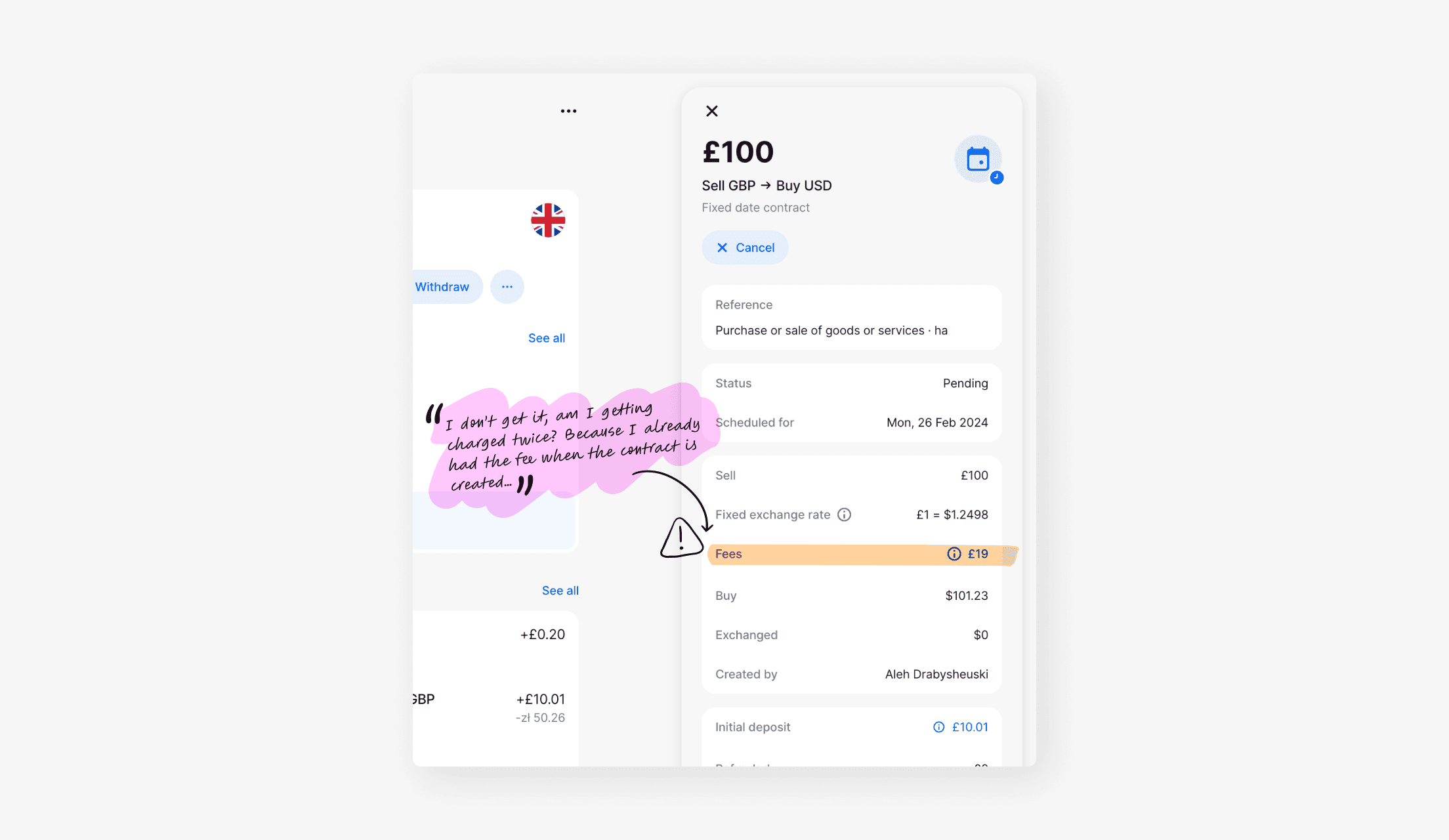

①
Lack of "Buy/Sell" clarity led to booking errors
②
Users need to do manual math for the final rate
③
The separate fees line triggered double-payment panic
①
Lack of "Buy/Sell" clarity led to booking errors
②
Users need to do manual math for the final rate
③
The separate fees line triggered double-payment panic
“
How might we elevate user confidence through pricing transparency to transform FX Forwards into a truly scalable, self-service workflow?
How might we elevate user confidence through pricing transparency to transform FX Forwards into a truly scalable, self-service workflow?
Designing for certainty
I translated these insights into a design strategy focused the revamp on two core pillars:
Make prices clearer to remove the fear of double charging.
Make actions obvious to avoid human errors during high-stakes operations.
Designing for certainty
I translated these insights into a design strategy focused the revamp on two core pillars:
Make prices clearer to remove the fear of double charging.
Make actions obvious to avoid human errors during high-stakes operations.
Designing for certainty
I translated these insights into a design strategy focused the revamp on two core pillars:
Make prices clearer to remove the fear of double charging.
Make actions obvious to avoid human errors during high-stakes operations.
Connect CMS Image fields (Image 1–10)
Pillar 1: Actionable clarity
To significantly reduce errors on high-value forward contracts, I replaced ambiguous inputs with the new single-arrow direction control to align with the broader Revolut ecosystem.
To ensure the trade direction remained unmistakable with the new UI, I implemented dynamic header titles with the BUY / SELL text to make the UI self-explanatory in all languages.
Pillar 1: Actionable clarity
To significantly reduce errors on high-value forward contracts, I replaced ambiguous inputs with the new single-arrow direction control to align with the broader Revolut ecosystem.
To ensure the trade direction remained unmistakable with the new UI, I implemented dynamic header titles with the BUY / SELL text to make the UI self-explanatory in all languages.
Pillar 1: Actionable clarity
To significantly reduce errors on high-value forward contracts, I replaced ambiguous inputs with the new single-arrow direction control to align with the broader Revolut ecosystem.
To ensure the trade direction remained unmistakable with the new UI, I implemented dynamic header titles with the BUY / SELL text to make the UI self-explanatory in all languages.
Connect CMS Image fields (Image 1–10)
↑
I also added visual tips to acknowledge the learning curve of this change.
Lastly, I integrated the user-entered free-text reference into the top-level contract view. Recognizing this as the primary way users differentiate between active trades without the need for extra clicks.
↑
I also added visual tips to acknowledge the learning curve of this change.
Lastly, I integrated the user-entered free-text reference into the top-level contract view. Recognizing this as the primary way users differentiate between active trades without the need for extra clicks.
↑
I also added visual tips to acknowledge the learning curve of this change.
Lastly, I integrated the user-entered free-text reference into the top-level contract view. Recognizing this as the primary way users differentiate between active trades without the need for extra clicks.
Pillar 2: Transparency ≠ Clarity
The legacy UI was indeed transparent by listing out the fee, but this ended up leading users to fear they were being double-charged.
So I unified base rate + fee into a single forward exchange rate. This replaced manual math with a net rate that users could instantly compare against competitors.
As a transparency trade-off aligned with Revolut's design principles, I moved markup details to a secondary layer. By de-emphasizing the fee as a separate line item, I reinforced that the cost was already baked in to the final rate.
Pillar 2: Transparency ≠ Clarity
The legacy UI was indeed transparent by listing out the fee, but this ended up leading users to fear they were being double-charged.
So I unified base rate + fee into a single forward exchange rate. This replaced manual math with a net rate that users could instantly compare against competitors.
As a transparency trade-off aligned with Revolut's design principles, I moved markup details to a secondary layer. By de-emphasizing the fee as a separate line item, I reinforced that the cost was already baked in to the final rate.
Pillar 2: Transparency ≠ Clarity
The legacy UI was indeed transparent by listing out the fee, but this ended up leading users to fear they were being double-charged.
So I unified base rate + fee into a single forward exchange rate. This replaced manual math with a net rate that users could instantly compare against competitors.
As a transparency trade-off aligned with Revolut's design principles, I moved markup details to a secondary layer. By de-emphasizing the fee as a separate line item, I reinforced that the cost was already baked in to the final rate.
Connect CMS Image fields (Image 1–10)
↑
I also worked with the team to align our language with industry standards. We chose spot / forward rates over current / final rates to ensure the tool sounded as professional and trustworthy as a human broker.
Finally, I surfaced inverted rates for both spot and forward views. This removed the cognitive tax for global users who think in different base currencies (e.g., a UK firm buying EUR vs. a European exporter selling GBP), allowing them to make decisions in their own mental model.
↑
I also worked with the team to align our language with industry standards. We chose spot / forward rates over current / final rates to ensure the tool sounded as professional and trustworthy as a human broker.
Finally, I surfaced inverted rates for both spot and forward views. This removed the cognitive tax for global users who think in different base currencies (e.g., a UK firm buying EUR vs. a European exporter selling GBP), allowing them to make decisions in their own mental model.
↑
I also worked with the team to align our language with industry standards. We chose spot / forward rates over current / final rates to ensure the tool sounded as professional and trustworthy as a human broker.
Finally, I surfaced inverted rates for both spot and forward views. This removed the cognitive tax for global users who think in different base currencies (e.g., a UK firm buying EUR vs. a European exporter selling GBP), allowing them to make decisions in their own mental model.
External outcome
By replacing ambiguity with clarity, we turned a high-touch manual process into a high-velocity digital platform, reflecting both in profitability and operational excellence.
External outcome
By replacing ambiguity with clarity, we turned a high-touch manual process into a high-velocity digital platform, reflecting both in profitability and operational excellence.
External outcome
By replacing ambiguity with clarity, we turned a high-touch manual process into a high-velocity digital platform, reflecting both in profitability and operational excellence.
7x
total txn value processed in 2024, winning 2023 by 62%
65%
increase in generated GP in 2024, exceeding the initial £1.1M target
30%
growth in additional contracts booked after users' first one
7x
total txn value processed in 2024, winning 2023 by 62%
65%
increase in generated GP in 2024, exceeding the initial £1.1M target
30%
growth in additional contracts booked after users' first one
7x
total txn value processed in 2024, winning 2023 by 62%
65%
increase in generated GP in 2024, exceeding the initial £1.1M target
30%
growth in additional contracts booked after users' first one
Internal impact
Beyond the product metrics, this project served as a benchmark for cross-team communication.
Following the final review, multiple product owners and designers from separate domains adopted my presentation framework. They cited the clarity of the narrative as a guide for broader stakeholder alignment.
Internal impact
Beyond the product metrics, this project served as a benchmark for cross-team communication.
Following the final review, multiple product owners and designers from separate domains adopted my presentation framework. They cited the clarity of the narrative as a guide for broader stakeholder alignment.
Internal impact
Beyond the product metrics, this project served as a benchmark for cross-team communication.
Following the final review, multiple product owners and designers from separate domains adopted my presentation framework. They cited the clarity of the narrative as a guide for broader stakeholder alignment.
Key takeaways
Transparency-profit trade-off: I balanced Revolut’s transparency ethos with business margin by layering rate details according to competitor patterns, which meets user expectations while protecting profitability.
Internal teams as research proxies: I leveraged sales and ops as research bridges. They provided the "why" behind the errors that data alone couldn't show, enabling a UI that actively prevents high-stakes mistakes.
Key takeaways
Transparency-profit trade-off: I balanced Revolut’s transparency ethos with business margin by layering rate details according to competitor patterns, which meets user expectations while protecting profitability.
Internal teams as research proxies: I leveraged sales and ops as research bridges. They provided the "why" behind the errors that data alone couldn't show, enabling a UI that actively prevents high-stakes mistakes.
Key takeaways
Transparency-profit trade-off: I balanced Revolut’s transparency ethos with business margin by layering rate details according to competitor patterns, which meets user expectations while protecting profitability.
Internal teams as research proxies: I leveraged sales and ops as research bridges. They provided the "why" behind the errors that data alone couldn't show, enabling a UI that actively prevents high-stakes mistakes.
Another story
Designing a 0-to-1 in-app product to launch a global telco giant into the green energy market

Another story
Designing a 0-to-1 in-app product to launch a global telco giant into the green energy market